
SPHP Takes Action to Protect Patients and Hospital Colleagues Against Workplace Violence
August 19, 2026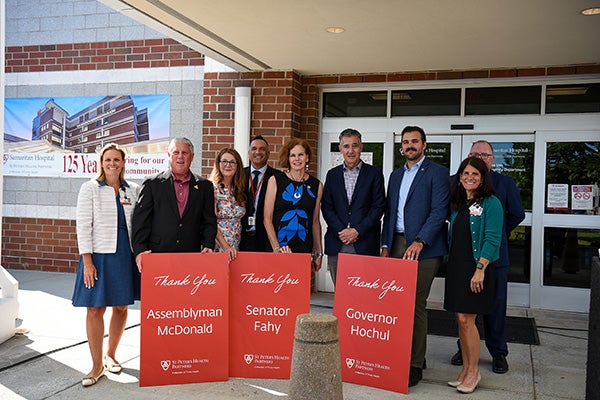
St. Peter’s Health Partners (SPHP) leaders joined New York state lawmakers on Friday, August 14, to formally announce the passage of legislation granting peace officer status to security officers at three SPHP acute care facilities.
SPHP sought the expanded authority to combat rising incidents of violence against healthcare workers – acts that have seen colleagues punched, kicked, bitten, and verbally assaulted while trying to provide patient care. Over the past six years, acts of aggression against hospital staff have more than doubled within St. Peter’s Health Partners’ acute care facilities. Violence at St. Peter’s Hospital alone increased 144%.
“Our colleagues are increasingly becoming victims of workplace violence, injured by the very people they are trying to help,” remarked Steven Hanks, M.D., president and CEO, SPHP and St. Joseph’s Health in Syracuse. “Across our hospitals, nurses, techs, social workers, and providers are being physically assaulted and verbally abused daily. It often happens without warning, and often while simply trying to provide basic patient care. It is an epidemic of dangerous behavior that is escalating ever faster and impacting our ability to care for the community.”
Assembly bill A10518 and Senate bill S9328, sponsored by Assemblymember John McDonald, III (D – Cohoes), and Senator Patricia Fahy (D – Albany), were signed into law by New York State Governor Kathy Hochul on July 24, 2026. The bills grant peace officer authority to trained security guards at St. Peter’s Hospital in Albany; Samaritan Hospital in Troy; and Samaritan Hospital’s Albany Memorial Campus in Albany. This enhanced status allows security officers to detain individuals, issue appearance tickets, and remove trespassers from hospital property.
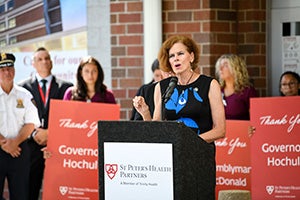 “We are incredibly grateful to Senator Fahy and Assemblymember McDonald for their leadership, advocacy, and unwavering support,” said Dr. Hanks. “The passage of this legislation marks a significant milestone not only for our healthcare system, but for hospitals across New York state. As healthcare organizations continue to face increasing incidents of workplace violence, this law provides trained hospital security personnel with an important additional tool to help deescalate potentially dangerous situations, respond more effectively when incidents occur, and enhance protections for patients, visitors, and healthcare workers.
“Most importantly,” Dr. Hanks continued, “it reinforces a shared commitment to ensuring hospitals remain safe places to give and receive care and sends a clear message that violence against healthcare professionals and those seeking care will not be tolerated.”
“As hospitals face increasingly complex public safety challenges and rising violence against healthcare workers, it’s important that we do what we can to allow hospital staff to focus on their first priority – their patients,” said Senator Patricia Fahy. “These specially trained hospital personnel can respond to incidents, deescalate, and manage the situation until local law enforcement arrives, ensuring the protection of staff, patients, and visitors. Protecting our healthcare workers is of the utmost importance, and I’m proud to sponsor this legislation; thank you to Assemblymember John McDonald for sponsoring this legislation in the Assembly and to Governor Hochul for recognizing its importance and signing it into law.”
Assemblyme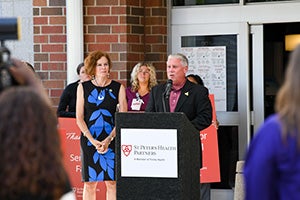 mber John T. McDonald III, RPh said, "Healthcare workers dedicate their lives to caring for others, and they deserve to work in a safe environment. That's why I was proud to sponsor legislation that was signed into law that will grant peace officer status to qualified security officers at Albany Memorial Hospital, Samaritan Hospital, and St. Peter's Hospital. Hospitals across New York have experienced a troubling rise in violence against healthcare workers in recent years. Emergency department staff, nurses, physicians, and other frontline employees are increasingly facing assaults and other dangerous situations while caring for patients. This legislation is designed to give specially trained hospital security personnel the authority to better respond to incidents, protect patients and staff, and safely hold individuals until local law enforcement arrives when necessary. I want to thank Senator Fahy for her partnership in advancing this important legislation, Governor Kathy Hochul for signing it into law, and Trinity Health for advocating for this measure to protect their employees."
With the legislation in place, the work now begins to develop and implement a peace officer program at SPHP. Led by Joshua Laiacona, Regional Director – Safety and Security Services for St. Peter’s Health Partners and St. Joseph’s Health, the program will be built upon enhanced training, professional standards, regulatory compliance, and appropriate oversight.
“Peace officer status carries significant responsibility and accountability, and we expect any future designees to meet standards that reflect the seriousness of that role,” said Laiacona. “We intend to proceed carefully, transparently, and in close partnership with local law enforcement, regulatory agencies, organizational leadership, our colleagues, and our communities.”
Obtaining peace officer status at acute care campuses is just one component of a much broader workplace violence prevention and public safety strategy SPHP has undertaken in recent years. The healthcare system has invested heavily in strengthening its security infrastructure, recruiting experienced public safety professionals, enhancing workplace violence prevention programs, implementing weapons detection technology, deploying staff duress systems, and expanding K-9 capabilities at St. Peter’s and Samaritan hospitals, as well as at its sister ministry in Syracuse, St. Joseph’s Hospital.
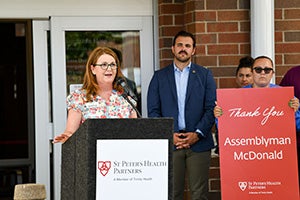
Since fiscal year 2020 (July 2019 - June 2020), Trinity Health New York (which includes both St. Peter’s Health Partners and St. Joseph’s Health in Syracuse) has made a significant investment in strengthening security operations, with total operating expenses increasing approximately $5.8M (a change of 119%). This amount represents operating expenses for the security departments only and does not include those security-related capital investments (e.g. access control enhancements, camera systems, and other infrastructure).
Samaritan Hospital Emergency Room nurse manager Judy Quinn, BSN, RN, is chair of SPHP’s recently formed Workplace Violence Committee. She says these security enhancements are necessary in today’s climate.
“In my 38 years as a nurse manager, I have never seen so many verbal and physical assaults on healthcare workers,” said Quinn. “The efforts by this organization and by legislators to ensure our colleagues feel supported and safe are deeply appreciated.”